
The In-Between
A short story.

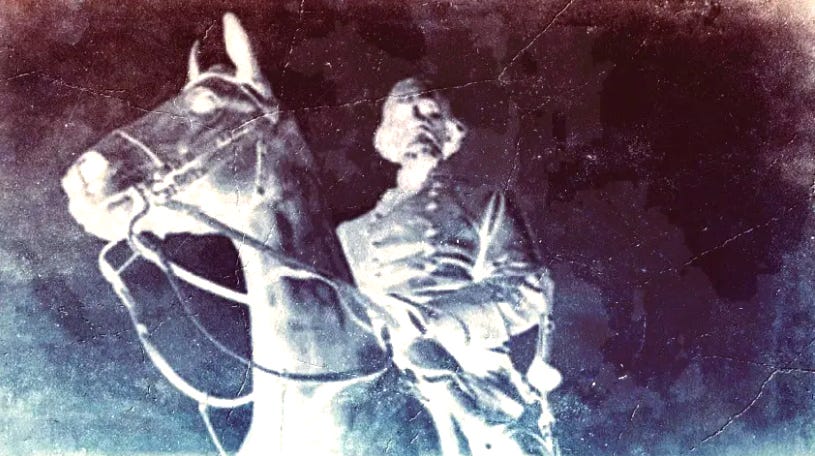
It was the last thing Tessa expected to happen on a lonely Tennessee backroad late at night during a driving rainstorm. But alas, there it was.
Boom.
The car shuddered, fishtailed into a skid, then swerved off the road. After shearing a pole holding a sign that read Entering Shiloh National National Military Park, her 1997 rattle trap Prius bounced down a steep embankment, pierced a jungle of understory and slowly flopped onto its top in a cloud of radiator steam. The front right tire was mangled, barely attached to the wheel.
Eventually, Tessa came to. She sensed that time had passed, but she wasn’t sure how much. The heart suddenly hammering in her chest led her to believe she was still alive. Whether she was in one piece? Still to be determined. She whispered to herself: Sweet Ababinili. What. The. Fuck.
Tessa heard rain pelting the bottom of the car, which, naturally, was above her body at that moment. Nothing in front of her eyes made sense. Rain trickling up the windshield? She’d come out of her seat belt and was on her side, the inflated airbag between her legs, looking up at the console and seats. Tessa’s phone, still attached to the dashboard clamp, scolded her with a course correction: Turn left…turn left…turn left. The embossed leather medallion dangled upside down from the rearview mirror—the spiral symbolizing the wind, which depicts life’s journey from birth to the afterlife for members of the Chickasaw Nation.
Was the afterlife just an upside down version of life itself? She wondered.
Tessa plucked the phone out of the holder with one hand and found the passenger door latch with the other, managing to open it. She wormed her way out of the car and stood up in a tangle of rain-soaked bushes, her body reeling and wobbling and jeans covered in the sticky remnants of a McDonald’s latte.
The rain had slowed to a drizzle. The air felt cool. Tessa looked up through the tree tops and saw a curtain of dark clouds parting to reveal a full moon on the stage of the clearing sky.
Just as she tasted something salty at the corner of her mouth (blood, tears, both?), Tessa heard footsteps and a metallic sound—a jingling—and the snorting exhalations from large lungs that could not possibly belong to a human being. But then a voice, which sounded very much like a human being.
“You look as if you could use some help,” the voice said. The horse and its rider stepped out of the mist and into a clearing under the moonlight, not fifty feet away from the car. Water dripped from the brim of the rider’s slouch hat. He wore a faded gray uniform adorned with fringed epaulets, a golden sash clenched around his waist. A sword dangled from the saddle and shimmered in the moonlight.
Tessa froze with her arms stretched out like wings—a bird preparing to take flight. But suddenly her arms flopped to her side, as if a puppeteer had released the strings. In slow motion she crumbled face down into a thorny blackberry thicket—the moon, the man and the horse all disappearing from her field of view.
* * *
Four hours earlier, at a student hangout near the University of Mississippi campus, Tessa stared mindlessly at the crusty dregs of leftover pizza on her plate. Margo, Tessa’s roommate who seemed to be cruising effortlessly through her own grad program, sat across the table.
“Quit? Now?” Margo asked. “You can’t be serious.”
“It’s just the thesis. I feel paralyzed.”
“How so?”
“The idea isn’t coming.” Tessa swirled the Merlot in her glass and drained it in three gulps. “I can’t see it.”
“Girlfriend, this doesn’t sound like the Georgia O’Keefe wannabe I used to know. Maybe you need to get away from the easel for a while. Stop looking for an idea. Let it find you.”
“How? Where?”
“I don’t know. Just get in the car and go.” Margo refilled their glasses. “Say, what about those Indian mounds you mentioned?”
“At Shiloh?”
“Only a couple hours north of here, right? You said you wanted to go—see your people.”
“Hmm.” Tessa thought for a few seconds, twisting the beaded turquoise bracelet on her wrist. Then she dropped a twenty on the table and slung her backpack over her shoulder. “Fabulous idea. Maybe I’ll find a Motel 6 up there somewhere tonight, spend all day with my people tomorrow. I owe ya.”
“Really?”
“No time like the present. See you Monday.”
After stopping at the apartment to stuff an overnight bag, Tessa headed north on a route that would take her past Shiloh that night on the way to nearby Savannah, Tennessee (“Catfish Capital of the World”), where she hoped to find that Motel 6 or at least something as cheap. Such were the expectations of a starving student artist faced with a Sallie Mae student loan balance of $46,983.24.
Along the way she passed a historical marker which made her think of home and her people. She wasn’t full blooded, but her grandparents were—both paternal and maternal. Tracing their lineage back to the tribe of people who were brutalized, murdered, raped, corrupted, sold into slavery and kicked out of the Tennessee Valley in 1837—leaving their trail of tears all the way to Indian Territory (aka Oklahoma) during the sad exodus.
Idling in the McDonald’s drive-thru, Tessa thought it strange to feel such a sense of loss and belonging all at once while traversing the original homeland of her ancestors.
As she handed the attendant her debit card, the first raindrop smacked the hood of the car.
* * *
Tessa woke up in a different place, her upside down Prius nowhere in sight. Oddly enough, she smelled like wet horse hair. Light flickered over her head on fabric of some sort, canvas maybe. She was stretched out on a cot. A cloud of smoke wafted in the air. When Tessa turned to cough, she noticed the man sitting next to her chewing on a cigar. A candle burned next to a decanter on a bedside table, illuminating the gold buttons on his uniform.
“Here,” the man said, standing up and filling a glass. He handed it to Tessa. “Brandy.”
She held it with a trembling hand, sniffing the edge of the glass. It smelled like peppermint. After taking a few wary sips, Tessa heard voices murmuring outside the tent. Laughing and singing. Heard the gentle strumming of a banjo and drum beats in the distance. Much closer, somewhere above the tent, an owl suddenly hooted. Tessa shuddered, bolted up on the cot.
“Where am I?”
“You are here.” The man smiled, snuffed out his cigar in an ashtray on the table. “How could you be anywhere else?”
She glared suspiciously at the man. “I don’t understand.”
“Perhaps we should take a walk. That is, if you’re able.”
Tessa stood up carefully. Even though she was vertical and above her feet, she couldn’t feel the ground under them.
The man put on his hat and drifted towards the entrance of the tent. He pulled back the flap. Tessa peered through the opening—awestruck by what she saw.
“What is this place?”
“The elder matriarchs—your people—call it It-tin-tuk-lah. I’ve heard it translated as the in-between. A state of suspension during which time we are purified before moving on to our respective states of grace. The foyer to the grand ballroom, so to speak.”
Tessa slowly stepped outside the tent. She turned to the man and tried to speak but couldn’t—her lips and voice now inoperable.
Suddenly a small, ebony-skinned boy streaked towards them and leaped into the man’s arms. The man laughed, then transferred the boy into the saddle of the horse. “Steady, old Roderick,” he said, gently brushing the horse’s neck with his hand. The boy looked down at Tessa and grinned shyly, chewing on his finger.
Then the man grabbed the reins and began slowly walking the horse and boy around the perimeter of what appeared to be a village. Tessa seemed to float beside them, filled with wonder and with no memory of what brought her there.
Six large mounds and enormous trees surrounded a large clearing. On top of each mound, a thatched roof structure built with vertical poles. A swirling bonfire roared in the middle of the clearing, its cyclone of sparks licking the blackness above. Human figures of every shape, size and color imaginable drifted across the open ground, each of their faces reflecting so much of the firelight they appeared to at times to be made of it. Some wearing skins and feathers, many dressed in tattered uniforms, others barely clothed at all. The humans seemed happy, moving between and in and out of various structures—huts and tents and shacks. Some of the younger children were rolling a stone across a small field and tossing spears at it. And animals—domestic and wild—wandered and mixed freely. Tessa saw a full-grown panther frolicking with a lamb and an old woman wearing a bear cub around her neck like a stole. Birds of every feather were perched on the outstretched wings of a thunderbird spirit pole, even hawks and doves preening peacefully side by side.
“You see,” he said, “none of us are ever ready for the ultimate destination. Each of us having much work to do? Consider yours truly. The once revered and feared General Nathan Bedford Forrest, a man full of such earthly venom. It is my understanding this place gives one a chance to improve, as it were, before we’re called forward. But I fear with my legacy I may have more work to do than most.”
As they walked along, Tessa noticed that some of the humans and beasts—their countenances suddenly flaring—vanished before her eyes.
Soon they’d completed the circumnavigation of the ethereal village and arrived back at the tent, at which point the boy slid down the side of the horse and skittered away into a rising mist.
After a gallant bow, the general opened the tent flap ahead of Tessa, and she wandered inside and sat down on the cot. He followed, sat down in the chair, then poured more brandy into the two glasses.
Tessa felt a warmth and looseness in her jaw, as she sensed her ability to speak had returned. And so she did. “Am I to…stay?”
“Heavens no!” he said with a playful scoff. “You are just a visitor.”
And then, at the moment the general picked up the candle to light a fresh cigar, his face flared and his icy blue eyes widened into what appeared to be a look of utter astonishment.
A second later, the chair was empty.
* * *
“Hey, girlfriend,” a familiar voice whispered softly in Tessa’s ear.
Tessa felt as if her eyelids were glued together, felt the tickle of her lashes batting and struggling to open.
“What?” Tessa said, struggling to form the word with such dry lips.
“It’s okay,” said Margo. “Just chill.”
“But…”
“You’re in the hospital. They had to airlift you to Memphis. But you’re going to be okay. Lots of bumps and bruises and a pretty bad concussion. A touch of what the doctor called cerebral hematoma. Your family’s on the way from Oklahoma.”
Tessa smiled, even as she finally remembered the crash and felt a throbbing pain in her head. Naturally, she was happy to be alive and happy to see a familiar, friendly face. But also quite happy about something else.
“My…”
“Your…what?” Margo placed the tip of a drinking straw on Tessa’s lips. She sucked the ice water in, swished it in her mouth, swallowed and sighed heavily.
“Thesis.”
“Your thesis?”
“Yeah,” said Tessa, winking at Margo. “I can see it now.”
#
I see this being a novel. Change the 1997 Prius to a 1984 Jeep Grand Cherokee. More irony huh?