
Vera Makes a Change
A short story.

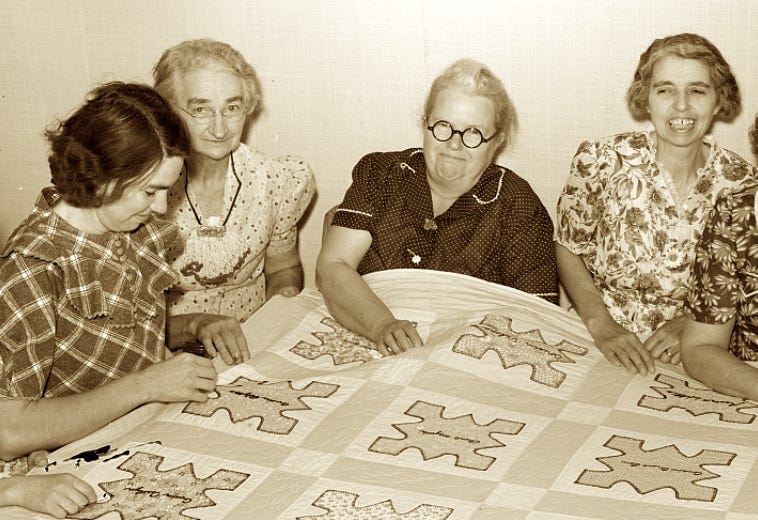
After a long absence, the four ladies of the Giles Street First Baptist Church were back at it again, gathered around the big table that supported their rickety quilting frame, each with their own calico bags filled sewing supplies, notions, batting, rags and miscellaneous cast-off remnants.
“If this old frame could talk…”
“We’d be in a lot of trouble, that’s what!”
“Hush!”
They snickered sheepishly at this exchange, realizing what a talking quilting frame might reveal about the ones who routinely gathered around it on rainy Saturday afternoons while eating deviled eggs, drinking punch the color of snapdragon buds and arguing the merits of one pattern over another. And, of course, it was not lost on any of them that Jesus was also watching from above the mantle in the parish hall. Leaning on a rock in the Garden of Gethsemane with prayerfully clasped hands, his pre-crucifixion eyes glowing sadly in the heavenly light from above.
Eunice, Imogene and Agnes—all perennial blue-ribbon winners at the Cullman County Fair—did most of the talking. Vera was the youngest, just a girl, really, an apprentice who never said much at all unless it was to ask one of the older ladies a technical question about the job at hand.
“Lost his leg, you say?”
“So tragic, all these boys coming home without all the parts the good Lord gave them.”
“Better that than dead, I ‘spect.”
As usual, each lady presented their raw materials bunch-by-bunch for consideration and discussion.
Not surprisingly, Eunice, the self-proclaimed queen of the quilting quartet by virtue of her seniority and officious nature, went first. “Oh, you know me! Miss Hodgepodge! One of my old linen honeymoon dresses, a little lace, a little velvet and some leftover herringbone from that double-breasted suit I made for Carl.”
“And he looks so dashing in it!”
“Indeed he does! Just like Leslie Howard in Pygmalion!”
Imogene dumped her bag on the table and out fell a pile of washed-out denim scraps, a pair of frayed pinstripe trousers, numerous argyle socks and paisley bandanas. “I cleaned out Henry’s bottom drawer.”
“Well, I hit the rayon jackpot at the thrift shop!” Agnes, right proud of herself, opened her bag and pulled out a frilly pink ballerina tutu, a shark-skin sport jacket the color of an avocado and a pair of yellow and white striped trousers—a garment that surely once hung in a circus clown’s closet.
Eunice had a way of smiling and smirking at the same time, one slightly obscuring the other depending on the aura she wanted to project. This time she was more smirk than smile. She turned to Vera, glaring over the top of her glasses. Only a hawk hunting the winter landscape for a helpless baby bunny might’ve looked more focused.
“Hon?”
Vera bent over, picked up a large, olive-drab bag and lugged it away from the table into an open area of linoleum. Then she unclasped a buckle at the top of the duffle bag, still covered in the mud and grime of a far-away continent that was now in better hands after V-E Day. Frail as a sparrow but demonstrating a surprising amount of strength, she hoisted the bag above her shoulders and out slipped a large bundle of red fabric onto the floor.
“Sonny brought it home.”
It took her some time to unfold the fabric, but once she did, it draped every chair and coffee table and stretched from one end of the parish hall to the other.
There was a stunned silence at the table—each mouth a wide-open sepulcher of shock—as the eyes surveyed the object of horror laid out before them, and in the house of God no less: a Nazi flag as big as the side of a barn.
“He called it a souvenir.” Vera planted her hands squarely on her bony hips. Shook her head. “But now he says he don’t want it around no more.”
Then, from the witnesses, every molecule of oxygen in the air seemed to be sucked into the collective gasp. Imogene reeled wordlessly, but the other two caught her by the arms before she crumbled to the floor.
“My heavens!” bellowed Eunice, her glasses tumbling off her nose and into her pile of scraps.
Agnes could only manage a whisper, but an apt one. “For where God built a church, there the Devil would also build a chapel!”
Vera crossed her arms, looked down at her feet and said nothing for a long time. Then finally, “It’s good fabric—wool bunting. Best I ever did see. Besides, it’s all I got.”
“Young lady, you get that hideous thing out of my church this instant!” Eunice huffed with a scarlet-painted face, trying to catch her breath. “And you are not welcome at this table ever again. Is that understood?”
Momentarily fazed and puzzled, Vera felt the blood gush up through her neck. She quickly gathered up the flag, stuffed it back into the duffle back and headed for the exit. She didn’t dare meet Eunice’s eyes on the way out for fear they would slice her in half.
But once outside and onto the sidewalk, Vera did allow herself one whimper in retaliation.
It ain’t your church.
***
It was a long walk home for Vera. Longer than usual.
Back through town, past the fancy town houses with the fancy ornate porches and pots overflowing with purple zinnias and fancy cars parked in the driveways. Vera rarely stared at or spoke to the people sitting on the porches, unless she was spoken to first.
She wasn’t very fancy and that was how her life had turned out, although there were times when Vera thought indoor plumbing might be nice to have.
Maybe Sonny would get “that job” soon.
The train whistle blew. She broke into a trot, hoping to beat it, the duffle bag flopping around on her thin, bony shoulder. But when she got to the tracks, it was too late. The L&N dining car was crawling by like a lazy caterpillar, slow enough that Vera could make out a wine label glued to a bottle sitting on a table in the window.
Virginia Dare.
It would be nice to ride a train one day, Vera thought, sit with Virginia at one of those fancy white tablecloths. Make friends with her. Maybe learn something from her.
Like how to hit back and not feel bad about it.
She got home at dusk and found Sonny asleep on the sofa, an empty pint bottle on the coffee table. He mumbled when Vera tiptoed past him towards the kitchen, which was really just a corner of the living room.
Vera softly dropped the duffle bag on the curling linoleum, stood over a sink full of dirty dishes and made up her mind that she would stop wishing for things to change.
Wishing, she decided, never changes anything from bad to good.
Only doing does.
***
The following Saturday, everything on the quilting frame had been stretched taut as usual—top, batting and backing. But without Vera’s presence, the conversation was anything but taut.
Eunice’s lips seemed to be the loosest.
“Well, I just hope she appreciates the fact that we taught her everything she knows.”
“We did that!”
“Such an embarrassment.”
“Allowed her to come in here and do something constructive with her life.”
“Do you think she didn’t know any better? That side of town, and all?”
“But how can you have a husband go off to Belgium…”
“…and fight in the war and her not know what that horrible thing stands for?”
“Well, knowing him and his passel of kinfolk, he probably did more drinking than fighting anyway.”
“That side of town, and all.”
“They stick together, that’s for sure!”
“Pastor said they don’t even have hot water. Said he saw a chicken in the house once—and not on a platter!”
“Can you imagine! And did y’all see the bruises on that child’s…”
“Well, if they’d ever darken the door of this church they might be a little more blessed.”
“Amen, sister!”
“Amen!”
Slowly, with each stitch—and as each Saturday melted into another—hearts and pineapples began appearing on alternating blue and green blocks across the top layer of fabric.
Symbols of love and hospitality.
***
For the first time in her life, Vera sniffed the fresh ink on a brand new library card.
“Thank you for your help, ma’am.”
The attendant smiled. “Of course. Enjoy!” She slid three books across the counter: A Treasury of 19th Century Quilting, Egg Money Quilts and You Can Make a Quilt!
Over time, Vera read every word of each book, marveled at the photos and diagrams. One day she bought an antique quilting hoop at the thrift shop, a ring-like device that would make it possible for her to create a quilt by herself.
Then she got to work.
And since she didn’t have a suitable space at home—and didn’t want Sonny to see what she was up to anyway—Vera ended up working on the quilt in a neighbor’s crib barn. But she always kept the flag out of sight, at least until she could cut it up and change it according to her plan. After that, she spent every spare minute sketching, measuring, folding, stitching and ironing.
A rainy spring turned into a hot, dry summer.
Sonny stayed gone from the house for days at a time, but Vera’s mind never had room for anxious worry about him. The more she sewed, the more she created something without the help of anyone else—the “ladies” of the Giles Road First Baptist Church or the ex-G.I. who drank down his piddly disability check every month—the better Vera felt about herself. She even got a part-time job at the drugstore soda fountain, started hiding a solid quarter every week in a mason jar she kept buried behind the outhouse.
One day, a man came into the drug store and put up a poster in the front window.
CULLMAN COUNTY FAIR
September 3rd, 1946
Food, fun and frolics for the whole family!
Live music featuring Pee Wee King & the Golden West Cowboys!
Games, rides, livestock, mule races, 37th annual quilting competition
Little Miss Cullman Pageant and hay bale decorating for the kids!
Vera wondered.
Hers had turned out sort of simple and plain, and only one dominant color. Still, she liked the design, was even proud of it. But could she ever hope to compete against such an array of elaborately beautiful works of art?
After being treated so badly, maybe that wasn’t even the point.
As she decorated a customer’s banana split with walnuts and cherries, Vera’s heart skipped a beat with unexpected anticipation.
***
A month later, Vera loitered near the back of the main fairgrounds hall, hoping the announcement would come soon. Deep-fried and candy-sweet aromas wafted in through the doors from the midway, along with the earthier smells of hogs, goats, sheeps and cattle. She felt self-conscious in her old blue-plaid day dress, the only one she owned. But at least it was clean and pressed.
She could see several colorful quilts hanging on the front wall under the spotlights, people touching and admiring them. Hers, however, was folded and draped on a shadowy rack off to the side, along with several others.
Eunice, Imogene and Agnes, dressed in their Easter finest, strolled around in the spotlights, tossing their heads back in laughter and rubbing elbows with the judges.
A few minutes later, a judge wearing a pink pill box hat walked up to a podium microphone and began talking.
“And here we have it, ladies and gentlemen! What you’ve all been waiting for…the winners of the 37th annual Cullman County Fair quilting competition. Third place goes to Doris Townsend for her cute kittens and puppy dogs. Second place to Sarah Pilkington for her log cabins in the cotton. And not surprisingly, this year’s first-place award goes to…the ladies of the Giles Street First Baptist Church for their cheery hearts and pineapples!”
Vera could see Eunice, Imogene and Agnes cackling in unison, scooting over to the podium to accept their blue ribbon.
A good time to make her getaway, she decided.
She slipped along the side wall and lifted her quilt off the rack. But as she turned to make for the nearest exit, an older couple waylaid her.
“I simply adore your quilt!” the woman said. Vera couldn’t help notice the fine silk scarf wrapped around the woman’s neck. The man, a dandy in a pinstripe suit and starched-up collar, raised his eyebrows and smiled.
Vera kept trying to push forward through the door, but then after hearing an echo of the woman’s comment in her mind, she stopped cold.
“Lovely fabric! Where did you get it?”
Stunned by the compliments, Vera’s mind went blank. Then, after a second to compose herself, she replied with the truth—just not every stitch of it.
“From a flag.”
“I like the alternating black and white triangles. Such a stunningly simple combination with the red.”
“Well, ma’am” Vera said, looking at the cracked concrete between her worn-out, thrift store saddle oxfords, “they’re not really triangles.”
“Excuse me?”
“Each one is the fourth letter of the Greek alphabet—Delta—which represents the change of any changeable quantity. I had a quantity of changeable fabric, so I just changed it.”
Vera couldn’t believe her ears. Neither could the couple, apparently, shocked into a moment of silent bewilderment.
“I learned it in a library book.” Vera added, as if to apologize but also feeling the sudden tension of something unusual on her face: a smile of satisfaction.
“How charming!” the woman chirped. “Will you take a hundred dollars for it? Grady, dear, get out your wallet.”
Vera gulped and nodded, imperceptibly at first but then more obviously, like one of those toy bulldogs with the bobbing heads they sold at the drugstore. The man revealed a fresh, sharp-edged bill, placed it in Vera’s palm and closed his fingers around her hand, patting it gently. “Thank you, my dear.” She handed over the quilt, which the woman received into her arms with bright-eyed joy, as if receiving a newborn baby.
***
The two-mile walk home took Vera again through town. The L&N had just pulled into the station and, once again, blocked her way. Motionless this time, but the sound of the big diesel engines rumbled impatiently as if it would at any moment chug off into the humid night air.
Vera stopped in her tracks and stared at it, feeling the thin miracle of the one hundred dollar bill in her shoe.
The dim glow of the depot ticket office window suddenly drew her attention. She drifted towards it like a moth that had spent too much in the darkness.
There was no line, so Vera made one by walking up to the counter. Over the agent’s shoulder, next to a large clock, she could see times and destinations on a placard attached to the back wall: Atlanta, Birmingham, Chicago, Jacksonville, Louisville and New Orleans.
“Yes ma’am?” he said, without looking up from his newspaper.
At long last, Vera knew what she wanted. She just didn’t know where she might find it, although one destination seemed to hold promise since the name sounded fancier than the others.
“How much to New Orleens?”
“Round trip, twenty dollars. One way, ten.”
Vera didn’t say anything at first, watched the red second hand slowly ticking around the clock. Then she saw herself boarding the train full of wonder and anticipation and eventually sitting down at that fancy dining car table with her new best friend, Virginia Dare.
“One way, please.”
#
Love this. Wish I had known Vera.
Thank you, Beth!